
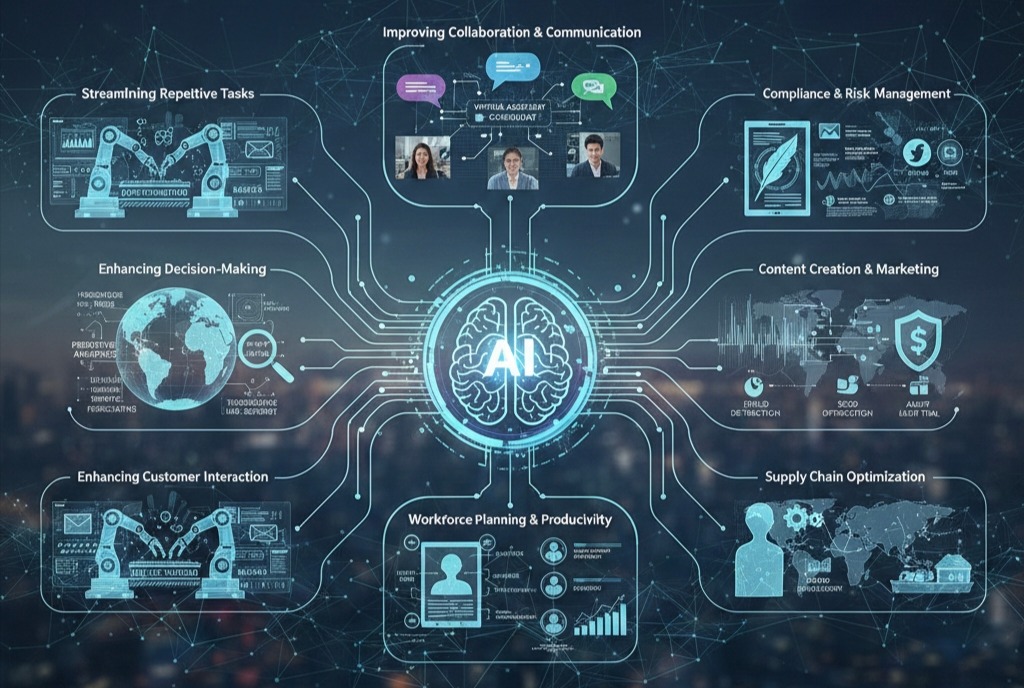
Artificial intelligence (AI) has moved beyond research labs and experimental applications. Today, it plays a central role in how businesses operate, streamline processes, and make decisions. AI tools are changing business workflows in tangible ways, reshaping routine tasks, communication patterns, and strategic planning.
Streamlining Repetitive Tasks
Businesses of all sizes are using AI to handle repetitive tasks. From data entry to report generation, AI reduces human error and frees employees to focus on higher-value activities. For instance, many companies rely on AI-powered software to automatically sort emails, flag important messages, or summarize long reports. Teams spend less time on mundane work and more time on tasks that require creativity and judgment.
AI tools are changing business workflows by automating these everyday tasks. This not only improves efficiency but also helps employees feel less burdened by routine duties. Over time, this can lead to higher job satisfaction and better overall performance.
Enhancing Decision-Making
Decision-making is another area where AI has a significant impact. AI tools can analyze large datasets quickly and identify patterns that humans might miss. This allows managers to make data-driven decisions with more confidence. Predictive analytics helps anticipate trends, understand customer behavior, and plan resource allocation more effectively.
For example, AI can forecast sales based on historical data, economic indicators, and market trends. This insight allows businesses to adjust strategies before problems arise. By reducing guesswork, AI supports more informed, strategic decisions at every level.
Improving Collaboration and Communication
Teams benefit from AI in collaboration and communication. Tools such as virtual assistants, chatbots, and AI-based scheduling software simplify daily coordination. Meetings, task tracking, and knowledge sharing become smoother and faster. Remote teams, in particular, gain from AI tools that reduce time spent searching for information and managing logistics.
AI tools are changing business workflows in ways that improve productivity and clarity. Employees can focus on contributing their expertise rather than managing administrative tasks. Workflows become more transparent and responsive, helping teams deliver results efficiently.
Enhancing Customer Interaction
AI has transformed how businesses interact with customers. Automated support systems, recommendation engines, and feedback tools provide faster, more personalized service. Customers receive timely responses, and businesses can maintain consistent communication without overloading staff.
For example, AI chatbots can answer frequently asked questions instantly while learning from past interactions to improve accuracy. Companies can analyze customer sentiment and adjust messaging to meet expectations. These tools complement human agents, allowing them to focus on more complex queries.
Seamless Integration
Successful adoption of AI depends on integration with existing systems. Tools that connect with project management, customer relationship management, and communication platforms ensure minimal disruption. Seamless integration allows AI to enhance workflows without replacing core processes.
Businesses often combine AI-powered analytics with operational software. This unified approach helps managers monitor performance, track progress, and adapt quickly. Integration ensures that AI becomes a natural part of daily operations, rather than an additional burden.
Automation in Content Creation and Marketing
AI also supports marketing teams in content creation. It can draft copy, suggest topics, and analyze engagement metrics. This allows teams to optimize campaigns, schedule content, and test messaging more efficiently. Human oversight remains essential to maintain quality and creativity, but AI handles repetitive or analytical tasks with ease.
By leveraging AI, marketers can respond faster to trends and adjust strategies in real time. The result is a workflow that is agile, informed, and data-driven. AI tools are changing business workflows by supporting decision-making and streamlining execution simultaneously.
Compliance and Risk Management
Compliance and risk management benefit from AI as well. Automated monitoring tools detect irregularities, flag potential breaches, and generate audit trails. This reduces manual work, increases accuracy, and helps businesses maintain regulatory standards consistently.
For instance, AI can analyze transactions or communications to identify unusual patterns that may indicate fraud. Businesses can then investigate promptly, reducing exposure to risk. This proactive approach supports safer operations and stronger governance.
Workforce Planning and Productivity
AI assists in workforce planning by analyzing performance metrics, project timelines, and resource allocation. Businesses can identify skill gaps, anticipate staffing needs, and assign tasks efficiently. This ensures that teams are neither overburdened nor underutilized.
AI tools are changing business workflows by making human resource management more precise. Managers can make decisions based on data rather than intuition alone. Employees benefit from clearer expectations and balanced workloads, leading to improved morale and output.
ALSO READ: Durostech.com Powers Digital Growth with Innovative IT Solutions
Supply Chain Optimization
In industries with complex supply chains, AI enhances efficiency by predicting demand, tracking shipments, and identifying bottlenecks. Real-time data analysis allows companies to respond quickly to disruptions. Inventory management becomes more accurate, reducing waste and cost.
AI tools are changing business workflows across operational levels. From procurement to logistics, decisions become faster and more informed. Businesses can maintain smoother operations, anticipate issues, and improve delivery timelines.
Future Implications
The evolution of AI means businesses will continue to adopt these tools in new ways. Workflows will become more data-driven, automated, and efficient. AI tools are changing business workflows by enabling a balance between speed, accuracy, and human insight.
Organizations that integrate AI thoughtfully will see long-term benefits in efficiency, customer satisfaction, and adaptability. These tools are not a replacement for human expertise but a complement, enhancing decision-making, productivity, and workflow management.
In summary, AI is reshaping business operations at every level. Repetitive tasks, decision-making, communication, customer service, compliance, workforce management, and supply chain operations all benefit from AI. Companies that understand and implement AI effectively will see more streamlined workflows and better outcomes. The shift is ongoing, and businesses that adopt AI thoughtfully will maintain a competitive edge while keeping their workflows fully attractive and unique.