
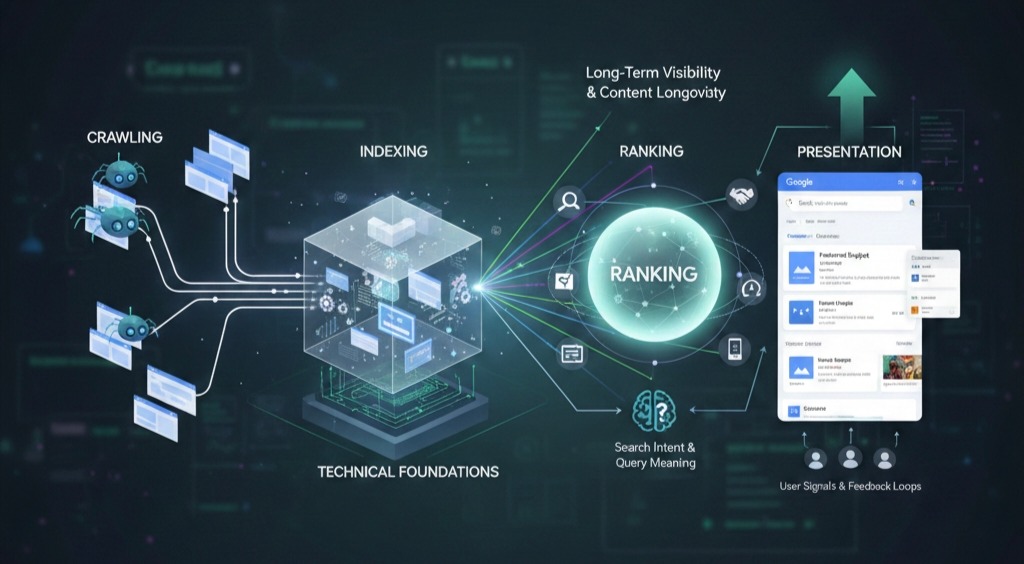
Google Search is often treated like a single product. In reality, it is a wide system made up of many connected parts. Each part plays a specific role in how information is discovered, ranked, and presented to users. When these parts work together, they shape what people see online every day.
To understand how search really works, it helps to stop thinking in terms of tricks or shortcuts. Search results are shaped by structure, signals, and behavior over time. This article breaks down that structure in a clear and practical way, without hype or technical overload.
Search as a System, Not a Tool
Search is not just a box where people type questions. It is a living system that responds to content, context, and intent. Pages are not ranked once and left there. They are evaluated repeatedly as signals change.
This system includes crawling, indexing, ranking, user feedback, and presentation layers. Each layer has its own purpose. When one part changes, the rest adjust around it.
The Google Search Ecosystem works this way by design. It favors consistency over quick wins. That is why short-term tactics often fade while stable sites continue to perform.
Crawling: How Information Is Discovered
Before anything can rank, it has to be found. Crawling is the discovery phase. Automated systems scan the web by following links and reading page structures.
Well-linked pages are easier to find. Clean navigation helps. Clear internal links guide crawlers through a site naturally. Broken paths slow discovery.
Crawling does not mean ranking. It only means the page is visible to the system. Many pages are crawled but never surface in results. Discovery is only the first step.
Indexing: Deciding What Matters
Once content is crawled, it is processed and stored. This is indexing. During this stage, content is evaluated for clarity, relevance, and structure.
Pages with duplicate content, weak signals, or unclear purpose may be indexed but deprioritized. Others may not be indexed at all.
Indexing is where structure matters. Headings, internal links, readable text, and consistent topics all help the system understand what a page is about. This is not about keywords alone. It is about meaning.
Ranking: Signals Over Shortcuts
Ranking is where most assumptions exist. Many believe rankings are driven by single factors. In practice, ranking is based on layers of signals working together.
Content relevance is one signal. Authority is another. User behavior plays a role as well. Page experience, speed, and clarity also contribute.
The Google Search Ecosystem relies on balance. A page does not rank because it is long or short. It Ranks because it solves a specific need better than alternatives.
This is why copied formats rarely work long term. Context matters more than formulas.
Search Intent and Query Meaning
Modern search focuses heavily on intent. Two people can type similar words but expect different results. The system adjusts for that.
Informational queries are treated differently than transactional ones. Navigational searches follow their own patterns. This affects which pages appear and how they are displayed.
Understanding intent changes how content should be written. Pages that clearly serve one purpose tend to perform better than those trying to cover everything.
Content Quality Beyond Words
Quality is not about complexity. Clear writing often performs better than dense explanations. Short sentences help. Logical flow matters.
Original insight stands out. Pages that feel written from experience often perform more consistently than those assembled from surface-level research.
This is one reason why evergreen articles continue to attract links and visibility. They do not chase updates. They explain fundamentals clearly.
Authority and Trust Signals
Authority is built over time. It comes from consistent publishing, relevant links, and stable behavior.
Links act as context, not just votes. A link from a relevant page adds meaning. A random link adds little.
Trust also comes from brand safety. Pages surrounded by clean content, neutral language, and stable topics tend to attract higher-quality references.
Within the Google Search Ecosystem, trust is cumulative. It grows slowly and fades slowly. Sudden spikes rarely last.
User Signals and Feedback Loops
Search systems observe how users interact with results. This does not mean every click changes rankings instantly. It means patterns matter. If users return quickly to results, it signals mismatch. If they stay and engage, it suggests relevance.
These feedback loops help refine rankings over time. They are not about manipulation. They are about matching expectations. Clear formatting, readable layouts, and honest titles support positive engagement.
SERP Features and Presentation
Search results are no longer just blue links. Featured snippets, knowledge panels, image blocks, and video results shape visibility.
These features change how traffic flows. Sometimes ranking first does not mean receiving the most attention.
Understanding presentation helps set realistic goals. Some pages are better suited for snippets. Others perform well as in-depth resources. This presentation layer is part of the Google Search Ecosystem, even though many overlook it.
The Role of Freshness and Stability
Not all topics need constant updates. Some benefit from stability. Others require freshness. News and trends favor recent content. Guides and explanations favor clarity and consistency.
Knowing which category a topic falls into helps shape content strategy. Forced updates can hurt more than help. Stable content often attracts steady links over time, especially when written in a neutral tone.
Technical Foundations Without Obsession
Technical health matters, but it is not everything. Clean code, fast loading, and mobile usability support performance.
However, perfect scores do not guarantee rankings. Technical work supports content. It does not replace it.
Balanced sites focus on fundamentals and move on. Over-optimization often creates unnecessary risk.
Why Ecosystem Thinking Matters
Looking at search as a system changes how decisions are made. Instead of chasing updates, focus shifts to clarity and relevance.
Instead of forcing keywords, meaning is prioritized. Instead of quick links, contextual references are earned.
This mindset aligns with how the Google Search Ecosystem evolves. It rewards patience and consistency.
Long-Term Visibility and Content Longevity
Pages that explain concepts clearly tend to age well. They become references. They attract natural links. This is why many high-performing pages are not flashy. They are useful.
Evergreen content supports stable traffic and steady authority. It also creates a safe environment for contextual link placements.
A Practical Way to View Search
Search works best when treated as an information system, not a marketing channel. When content serves users first, signals align naturally.
Writers who understand this tend to produce content that lasts. Their pages do not rely on trends. They rely on clarity.
The Google Search Ecosystem reflects this balance. It favors pages that explain, guide, and inform without pushing.
Final Perspective
Search is not mysterious, but it is layered. Each layer supports the next. Crawling enables indexing. Indexing supports ranking. Ranking responds to users. Understanding these relationships leads to better decisions. It also leads to content that earns trust over time.
The Google Search Ecosystem continues to evolve, but its core goal remains steady. It aims to connect people with information that makes sense. When content respects that goal, visibility follows naturally.