
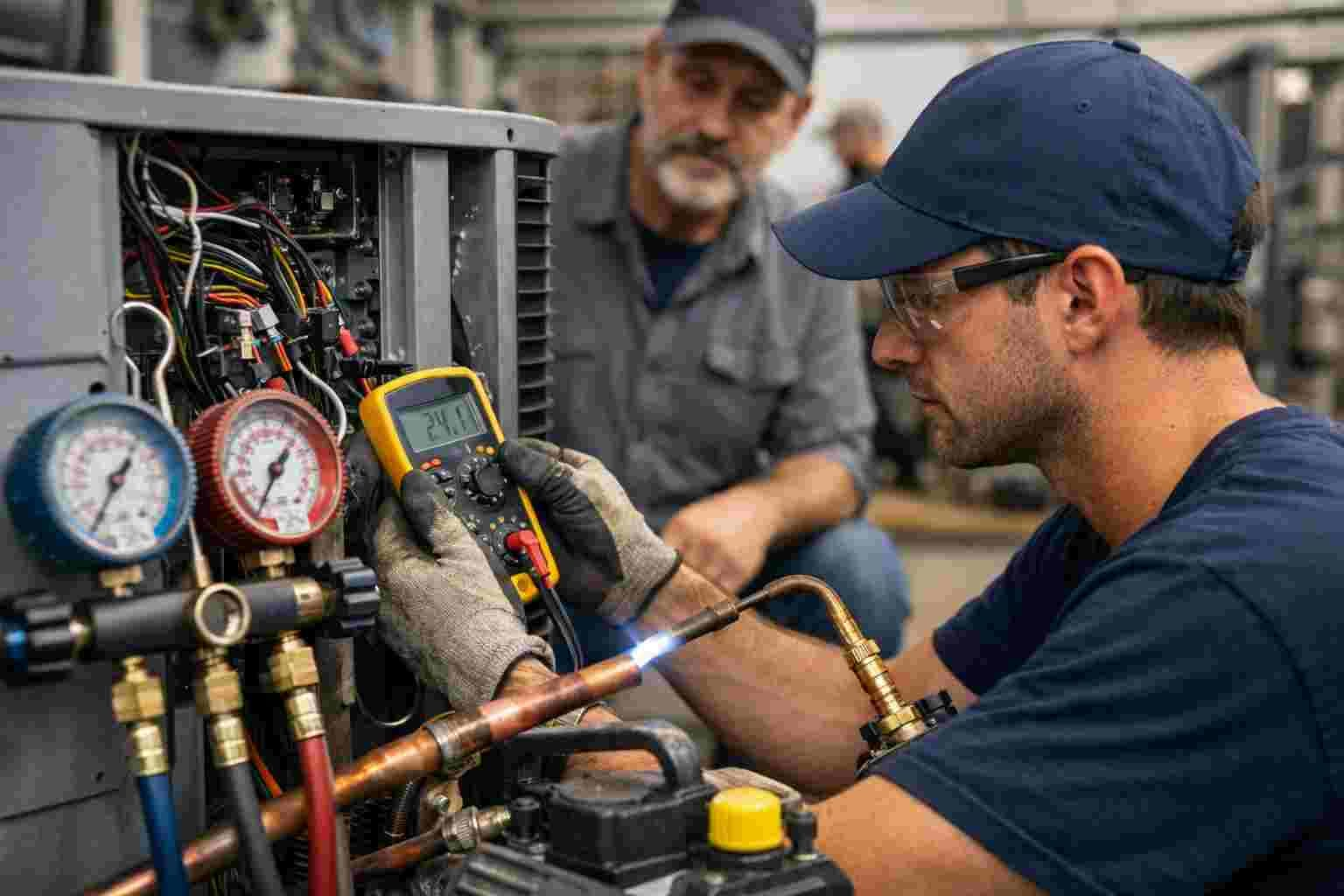
Hands On HVAC Training is where real skill begins, especially for people who are tired of just reading manuals and watching videos without ever touching real equipment. Many beginners enter the HVAC field thinking theory will be enough, but the first time they face a live system with wiring, pressure readings, and a unit that refuses to start, they realize something is missing. That missing piece is practical experience. You don’t truly understand airflow until you measure static pressure yourself. You don’t fully grasp electrical troubleshooting until your meter shows zero volts where power should be. Real confidence comes from handling tools, making small mistakes, and correcting them under guidance. This kind of training bridges the gap between classroom knowledge and real-world service calls. It prepares you not just to understand HVAC systems, but to diagnose, repair, and install them with clarity and control.
Introduction: The Gap Between Knowing and Doing
A lot of people can explain how an air conditioner works. Fewer can fix one when it stops cooling in the middle of July.
That gap is where most beginners get stuck.
You can watch videos. You can read manuals. You can memorize refrigeration cycles. But when you’re standing in front of a real system, tools in your hand, gauges connected, and a customer waiting — theory alone doesn’t help much.
That’s why Hands On HVAC Training matters so much.
If you’re thinking about joining a program, or you’re already enrolled and wondering what it will really be like, this guide will give you a clear picture. No fluff. No sales talk. Just practical insight from how real training environments work.
If you’re serious about building real technical skills, choosing the right school matters. Quality Training Center focuses heavily on practical lab work instead of just classroom theory. Students spend real time working on live HVAC systems, testing electrical components, checking refrigerant levels, and practicing installation procedures. This approach helps you gain confidence faster. Instead of memorizing concepts, you learn how to solve real problems step by step, just like you would on an actual service call.
Why Practical HVAC Training Is So Important
HVAC is not a desk job. It’s a trade. And trades are learned by doing.
You can’t build confidence by reading alone. You build it by:
- Wiring actual thermostats
- Brazing copper lines
- Charging systems with refrigerant
- Troubleshooting units that don’t behave perfectly
In Hands On HVAC Training, you work on real equipment. You make mistakes. You fix them. That process builds skill faster than any textbook.
Most employers don’t just want someone who “knows.” They want someone who can diagnose under pressure.
What You’ll Actually Work On During Training
Let’s break it down clearly.
1. Basic Tools and Safety
Before touching systems, you’ll learn tools.
You’ll handle:
- Manifold gauge sets
- Multimeters
- Clamp meters
- Vacuum pumps
- Recovery machines
- Brazing torches
You’ll also learn electrical safety. This is serious. HVAC involves high voltage and pressurized refrigerant. A good Hands On HVAC Training program drills safety into you from day one.
Practical tip:
Get comfortable using a multimeter early. Most troubleshooting comes down to voltage and continuity checks.
2. Understanding the Refrigeration Cycle (In Real Life)
Yes, you’ll learn the theory. But more importantly, you’ll see it working.
You’ll:
- Check superheat and subcooling
- Read pressure-temperature charts
- Diagnose low refrigerant vs airflow problems
- Identify compressor issues
In class, superheat is just a formula. In real systems, it tells you whether the evaporator is starved or flooded.
That’s where Hands On HVAC Training becomes powerful. You see cause and effect.
Example:
Low suction pressure?
Could be low refrigerant.
Could be a dirty evaporator coil.
Could be a restricted metering device.
You learn how to tell the difference.
3. Electrical Troubleshooting
Most HVAC service calls are electrical.
You’ll work on:
- Contactors
- Capacitors
- Relays
- Control boards
- Thermostats
You won’t just learn what they are. You’ll test them.
You’ll simulate faults. Instructors may disconnect wires or create issues and ask you to diagnose the problem.
That’s real-world training.
Personal insight:
Many beginners fear wiring. After a few weeks of real troubleshooting practice, that fear disappears. Confidence comes from repetition.
4. System Installation Practice
Installation work is different from repair.
You’ll learn:
- Proper line set sizing
- Brazing techniques
- Leak testing
- Evacuation procedures
- Proper refrigerant charging
If evacuation isn’t done correctly, moisture stays in the system. That causes long-term damage. A strong Hands On HVAC Training program makes you practice pulling deep vacuums and checking micron levels properly.
Small details matter in HVAC. Training teaches those details.
5. Furnace and Heating Systems
HVAC isn’t just cooling.
You’ll work on:
- Gas furnaces
- Ignition systems
- Flame sensors
- Heat exchangers
- Blower motors
You’ll learn how to safely test gas pressure and check combustion components.
Heating calls can be more dangerous than cooling. Proper hands-on exposure prepares you for winter service situations.
Step-By-Step: How Skills Build Over Time
Good training follows a progression.
Step 1: Observation
You watch instructors demonstrate.
Step 2: Guided Practice
You perform tasks with supervision.
Step 3: Independent Practice
You troubleshoot systems alone while being evaluated.
Step 4: Simulated Real Calls
You’re given a problem and expected to solve it like a field technician.
In strong Hands On HVAC Training, instructors don’t just tell you the answer. They ask questions.
“What’s your voltage reading?”
“What should it be?”
“What does that tell you?”
That thinking process builds real technicians.
What Beginners Usually Struggle With
Let’s be honest. The first few weeks can feel overwhelming.
Common struggles:
- Reading wiring diagrams
- Understanding pressure readings
- Remembering sequence of operation
- Brazing without leaks
- Diagnosing intermittent faults
This is normal.
Here’s what helps:
- Take notes during lab time
- Repeat tasks until they feel natural
- Ask “why” instead of memorizing
The more repetition you get in Hands On HVAC Training, the faster confusion turns into clarity.
What Makes Great HVAC Students Stand Out
From experience, the strongest students:
- Stay curious
- Practice after class
- Volunteer to troubleshoot first
- Don’t panic when systems don’t behave normally
- Focus on fundamentals
HVAC isn’t about guessing. It’s about logic.
Airflow. Refrigerant flow. Electrical flow.
If you understand those three systems deeply, you’ll outperform most beginners.
Immediate Tips You Can Apply During Training
Here are practical strategies:
Always Start With Airflow
Many new students assume refrigerant issues. But airflow causes many cooling complaints.
Check:
- Filters
- Blower operation
- Coil cleanliness
Airflow first. Refrigerant second.
Use Your Meter Constantly
Don’t assume power is present. Verify it.
Measure voltage at:
- Line side
- Load side
- Control circuit
This habit, developed during Hands On HVAC Training, will save you in the field.
Learn to Think in Sequences
HVAC systems follow an order.
For cooling:
- Thermostat calls
- Contactor pulls in
- Compressor starts
- Fan runs
If something fails, ask:
“Where in the sequence did it stop?”
That mindset turns chaos into structure.
Common Mistakes Students Make
Let’s talk about real errors.
1. Rushing Diagnostics
Guessing instead of testing wastes time.
2. Ignoring Safety
Skipping lockout procedures is dangerous.
3. Overcharging Systems
Adding refrigerant without confirming superheat/subcooling.
4. Poor Brazing
Leaks from bad joints are common in early practice.
5. Memorizing Instead of Understanding
This hurts long-term growth.
Strong Hands On HVAC Training programs allow you to make mistakes safely so you learn from them.
What Professionals Can Still Gain From Hands-On Training
Even experienced techs benefit.
Technology changes.
You may encounter:
- Variable speed systems
- Inverter-driven compressors
- Smart thermostats
- Advanced diagnostic tools
Returning for updated Hands On HVAC Training keeps skills sharp.
Field experience is powerful. Structured lab practice adds precision.
How To Know If a Training Program Is Worth It
Look for:
- Real equipment, not just demos
- Small lab groups
- Instructors with field experience
- Fault simulation exercises
- Refrigerant handling practice
If students rarely touch tools, it’s not true Hands On HVAC Training.
You should be working more than watching.
FAQ: Hands On HVAC Training
How long does hands-on HVAC training usually take?
Programs vary. Some run 3–6 months. Others last a year. What matters more than length is lab time.
More tool time equals better skill development.
Do I need prior experience?
No. Good programs start from basics.
Mechanical curiosity helps. But beginners succeed every day.
Is it physically demanding?
Yes, somewhat.
You’ll lift equipment. Bend. Stand for long periods. It’s a trade career.
Training prepares you physically as well.
Will I feel confident after completing it?
Confidence comes from repetition.
If your program provides true Hands On HVAC Training, you should feel comfortable diagnosing basic systems independently.
Can experienced technicians still benefit?
Absolutely.
Advanced diagnostics and modern systems require updated skills.
Hands-on refresher training often boosts earning potential.
Final Thoughts: What You Should Do Next
If you’re serious about entering HVAC, don’t settle for theory-heavy programs.
Choose real lab-based Hands On HVAC Training.
During training:
- Focus on fundamentals
- Ask questions constantly
- Practice wiring and meter usage daily
- Don’t fear mistakes
- Study airflow, refrigerant flow, and electrical flow deeply
HVAC rewards problem-solvers.
When you finish solid Hands On HVAC Training, you won’t just “know about” systems.
You’ll walk up to a unit that isn’t working, connect your gauges, grab your meter, and calmly figure it out.
That’s the real goal.
Skill. Confidence. Competence.
And those only come from doing.