
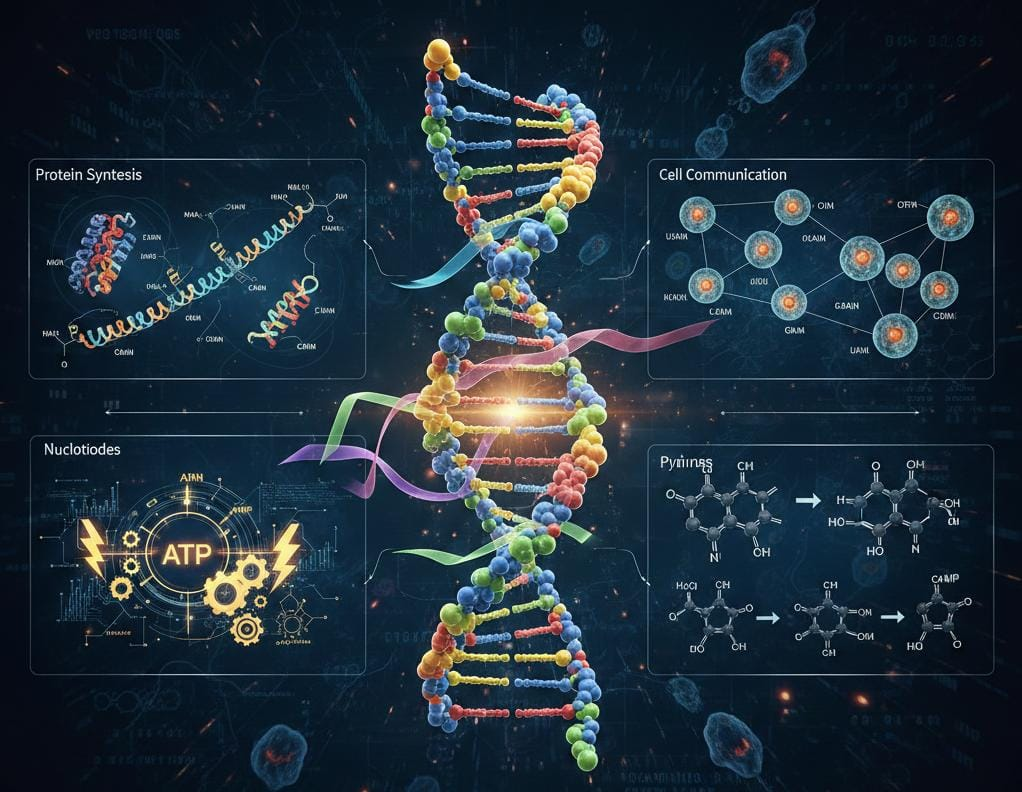
Life, at its most basic level, is made up of tiny molecules that store and transmit information. Among these molecules, nucleotidy hold a central position. They form the foundation of DNA and RNA, which are crucial for the storage and transfer of genetic information. Without them, cells would lack the instructions to function, grow, and reproduce.
What Are Nucleotidy?
A nucleotidy is an organic molecule composed of three main components: a nitrogenous base, a sugar, and a phosphate group. The nitrogenous base can be adenine, guanine, cytosine, thymine (in DNA), or uracil (in RNA). The sugar is either ribose (in RNA) or deoxyribose (in DNA). The phosphate group connects nucleotidy together, forming long chains that become DNA or RNA strands.
These molecules are simple in structure but essential for life. Their sequences determine the genetic code, dictating how proteins are built. Even small changes in these sequences can lead to significant differences in an organism’s traits or functions.
The Role of Nucleotidy in Genetic Information
DNA and RNA are long chains of nucleotidy. Each sequence of bases carries instructions for building proteins. Proteins, in turn, perform nearly all cellular tasks, from structural support to catalyzing reactions as enzymes.
RNA, built from nucleotidy, serves as a messenger. It transfers the genetic code from DNA to the ribosomes, where proteins are synthesized. Without these molecules, the instructions stored in DNA would never reach the machinery that creates proteins.
The precision of nucleotidy sequences allows cells to maintain stability. Errors in these sequences can lead to mutations, which sometimes result in diseases. Scientists study these sequences to understand heredity, genetic disorders, and evolutionary processes.
Nucleotidy and Energy Storage
Beyond genetics, nucleotidy are vital for energy management within cells. The molecule adenosine triphosphate (ATP) is a modified nucleotide. ATP stores and provides energy for cellular activities. Cells rely on this energy to grow, move, and divide.
Other nucleotidy-derived molecules, such as GTP, also participate in energy transfer and cellular signaling. Without them, metabolic processes would stall. In this way, nucleotidy are not only carriers of information but also essential components of cellular energy systems.
Nucleotidy in Cell Signaling
Cells communicate constantly. Nucleotidy play a key role here as well. Molecules like cyclic AMP (cAMP) and cyclic GMP (cGMP) are derived from nucleotidy. They act as messengers, transmitting signals from one part of the cell to another.
This signaling influences how cells respond to their environment, grow, or divide. By regulating these processes, nucleotidy contribute to the overall organization and coordination within living organisms.
Types of Nucleotidy
There are two main categories of nucleotidy:
- Purine nucleotidy – Adenine and Guanine
- Pyrimidine nucleotidy – Cytosine, Thymine, and Uracil
Purines have a two-ring structure, while pyrimidines have a single-ring structure. Both types pair specifically in DNA: adenine with thymine and guanine with cytosine. In RNA, thymine is replaced by uracil. This pairing is critical for the stability of the double-helix structure in DNA.
How Nucleotidy Influence Protein Synthesis
Proteins are the workhorses of the cell. They perform almost all functions, from catalyzing reactions to building structural frameworks. The sequence of nucleotidy in DNA determines which proteins a cell can produce.
During transcription, DNA sequences are copied into RNA sequences. Ribosomes read these RNA sequences, interpreting the code to assemble amino acids into proteins. Each triplet of nucleotidy bases, known as a codon, specifies a particular amino acid. This process ensures that proteins are built accurately and efficiently.
Nucleotidy in Modern Research
Nucleotidy have become essential tools in modern biology. Researchers use their properties to study genetics, develop therapies, and explore evolutionary biology. DNA sequencing, for example, relies on understanding nucleotidy sequences. By reading these sequences, scientists can identify genetic disorders, track pathogens, and study population genetics.
In medicine, nucleotidy analogs are used in antiviral drugs. These compounds mimic natural nucleotidy and interfere with viral replication. This demonstrates the practical importance of understanding these molecules.
The Link Between Nucleotidy and Cellular Health
Cells rely on the correct composition and sequence of nucleotidy for survival. Damage to these molecules can result in genetic mutations or errors in protein synthesis. Cells have repair mechanisms, but persistent damage can lead to aging or disease.
Maintaining healthy nucleotidy sequences ensures that genetic information is preserved and accurately transmitted. This is why they are central to studies of cancer, genetic disorders, and cellular aging.
Also Read: Refixs2.5.8a Features: What Makes This Update So Special?
Energy, Signaling, and Beyond
The versatility of nucleotidy extends beyond genetic information. ATP, GTP, and other nucleotide-derived molecules drive metabolic reactions, signal pathways, and enzymatic activities. These molecules act as connectors, linking energy management, cellular communication, and biological regulation.
Without nucleotidy, cells would lack both the instructions to function and the energy to act on those instructions. They are indispensable at multiple levels of biology.
Why Nucleotidy Matter
In simple terms, nucleotidy are essential because they:
- Carry genetic instructions
- Enable protein synthesis
- Provide cellular energy
- Facilitate communication within cells
- Support metabolism and enzymatic reactions
Every living organism depends on these molecules. They are the thread connecting heredity, growth, and survival.
Summary
Nucleotidy are small molecules with a big role. They are the building blocks of DNA and RNA, the source of cellular energy, and key messengers in cell communication. They influence protein synthesis, genetic stability, and overall cellular function. Studying them gives insight into the most fundamental processes of life.
Understanding nucleotidy helps scientists, doctors, and researchers explore genetics, medicine, and evolutionary biology. Their role spans from the microscopic activities inside a single cell to the development and functioning of entire organisms.
In biology, few molecules are as versatile and indispensable as nucleotidy. They quietly govern the operations that keep life running smoothly. Without them, life as we know it would not exist.